
The co-owners' meeting: The annual meeting in co-ownership
Table of contents
Who can convene the meeting of co-owners?
The meeting of co-owners is convened by the board of directors at least once a year or at any time if there is a need. The meeting of the co-owners may also be requested by co-owners if they represent 10% of the votes of the whole co-ownership [1] or if they represent a different majority as provided for in the declaration of co-ownership. In the latter case, the board of directors will then have 21 days to convene the said meeting of co-owners. Failing this, the signatories of the request may convene the meeting themselves at the expense of the syndicate of co-ownership.
Who is convened to this annual meeting?
When a meeting of co-owners is convened, it is mandatory to convene all the co-owners. Thus, if there are several co-owners per unit, they must all be convened. In certain exceptional cases, certain hypothecary creditors must also be convened if they have specifically notified the syndicate of co-ownership. The mandataries for whom the syndicate has received a mandate in due form, whether it be a general mandate or a mandate concerning the capacity of the person, must also be summoned.
What are the deadlines for holding a meeting?
The annual meeting of co-owners must be held within the delays set out in the declaration of co-ownership. If it is a special meeting, it may be held at any time during the year. It should be noted, however, that failure to hold the meeting within the delays and/or on the dates set out in the declaration of co-ownership does not appear to be sanctioned by law. Every declaration of co-ownership provides for a period between the convening and holding of the meeting of co-owners which must be respected. This notice is at least ten days but may be, in certain declarations, increased to 15 days prior to the date set for the holding of the meeting of co-owners. At no time may a meeting of co-owners be called more than 45 days before the date of the meeting. Subject to the rules specific to the virtual platform meeting of co-owners discussed below, the meeting is held in the city or at the location set out in the declaration of co-ownership.
What is a notice to attend the meeting? What information must it contain?
The notice is given by sending documents to the persons listed above in the section “Who is convened”. The notice to attend the meeting is the letter inviting the co-owners on a fixed date to hold a meeting of co-owners. It must be accompanied by the balance sheet of the co-ownership, the statement of income for the past fiscal year, the statement of debts and receivables, the provisional budget, any proposed amendments to the declaration of co-ownership and/or the by-laws of the immovable and a note on the essential terms and conditions of any proposed contract and any proposed work.
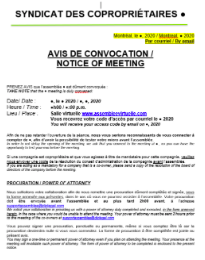
Thus, on an annual basis, the minimum documents that must be sent with the notice to attend the meeting are, if no draft by-laws or amendments to the declaration of co-ownership are submitted to a vote by the general meeting of co-owners.:
- balance sheet of the co-ownership,
- statement of results for the past fiscal year,
- statement of debts and receivables,
- provisional budget,
- essential terms and conditions of any planned work contract,
- power of attorney form.
In fact, these are the items which must be dealt with by all annual general meetings of co-owners. If it is a special meeting, only the items which are the object of the special meeting must be included in the agenda with the corresponding documents. It should be noted that failure to send these documents with the notice to attend the meeting at the time of the meeting will result in the impossibility for the co-owners to vote on the items covered by these documents. Many co-ownerships forget to send with the notice documents the note on the essential terms and conditions of any proposed contract and any proposed work. As this is a memorandum, it does not have to be a very elaborate document but should list the contracts and work with the name of the person or persons who have been selected to carry out the work, the dates of completion and the amounts if these are available.
This meeting notice and the accompanying documents must obviously be sent to all the co-owners, including those who have lost their right to vote for failure to pay their common expenses for more than three months. In this specific case, the notice will indicate the default and the possibility of remedying the default to recover one’s right to vote at the general meeting of co-owners.
What is an agenda? How must it be structured?

A basic agenda for a co-ownership meeting should cover the following items:
- establishment of a quorum ;
- election of officers of the meeting;
- presentation of the balance sheet, statement of income for the past year and statement of debts and receivables;
- consultation on the provisional budget;
- election of the board of directors;
This basic agenda may, at any time, be completed by specific requests according to the needs of the co-ownership, for example, by-law amendments, amendments to the constituting act, work requiring the approval of the meeting, etc. Any co-owner who receives the notice of meeting, the agenda and the accompanying documents has five days from receipt to request that certain items be added to the agenda. In addition to the time limit imposed on him to request the addition of an item to the agenda, it is necessary that the item be voted upon by the general meeting of co-owners.
If the item which is requested to be added by the co-owner does not require a vote or is not within the competence of the general meeting of co-owners, the board which receives such a request will not have to act upon it. If these are not items to be voted on, any co-owner, even without making a request, may, during the meeting, ask any question relating to the co-ownership. The ” varia ” item at the end of the meeting is the last opportunity for the co-owner to ask any question or submit any comment to the board of directors which has not already been answered during the meeting of co-owners.
Thus, when the board of directors receives a valid request to add an item to the agenda within the prescribed time limit, it shall send, prior to the co-ownership meeting, an amended agenda to the co-owners taking into account this addition.
Attending or designating a proxy for the meeting
Attendance at a meeting of co-owners may be in person or by proxy. A co-owner who is unable to attend a co-ownership meeting may, at any time, submit a proxy for another co-owner, whether a director or not, to vote on his or her behalf at the co-ownership meeting.
Although it may be desirable, there is no way to limit the number of proxies that can be held by one person. Thus, in some cases, a single person could hold the majority of the votes and decide alone on the relevant decisions at a co-owner meeting.

At the opening of the general meeting of co-owners, the co-owners present and represented by their representatives sign the attendance register [2].
Requirement for reaching quorum to start a meeting
For a meeting to be held and to begin, there must be a quorum, that is to say, the presence in person or by proxy of a majority of the votes of the whole co-ownership.
It is important to remember that the co-owners always vote according to the share (relative value) which they represent under the terms of the Declaration of Co-ownership. When the meeting does not have a quorum on the date and time specified in the notice of meeting, all declarations of co-ownership contain a waiting period to allow for the attainment or non-attainment of a quorum and the commencement of the meeting. Most declarations provide for a delay of 30 to 60 minutes. If this time limit granted by the Declaration of Co-ownership has elapsed and if a quorum has not been reached, the meeting must be postponed for a period which is, again, provided for in the Declaration of Co-ownership. A notice must be given to all co-owners of the new date. At this new meeting, three quarters of the members present or represented will automatically constitute a quorum, thus allowing a meeting to be held in any case at this last attempt [3]. If a quorum is reached, the meeting can then be opened and the first item to be dealt with is the election of the officers of the meeting, who are mainly the president and the secretary of the meeting. The role of the president of the meeting is to ensure that the agenda is respected and that the decisions taken are valid.
Some declarations of co-ownership may set out conditions which must be respected by the person wishing to preside over the meeting of co-owners, such as being a unit owner. The election of the president of the meeting is done by a majority of the votes present or represented at the meeting. The same vote applies to the secretary of the meeting who is responsible for taking notes for the purposes of the minutes of the meeting of co-owners. Once again, the Declaration of Co-ownership may provide for conditions to be met to be elected secretary of the meeting. Once these officers are elected, the agenda will be dealt with, item by item, by the chairperson of the meeting. When a vote is required, it is the responsibility of the president of the meeting to determine the majority of votes to be reached for each item and to declare, after the vote, whether or not the decision was validly taken by the co-ownership corporation. Voting is generally done by a show of hands, with the obvious exception of meetings held on a virtual platform where voting is done by electronic ballot. However, depending on the terms of the Declaration of Co-ownership, it is possible for a certain number of co-owners to request that the vote be taken in writing. It is important to remember that co-owners always vote according to the share (relative value) which they represent under the terms of the Declaration of Co-ownership.
In these circumstances, the president of the meeting shall proceed with the written vote by handing out ballots and, once again, the written vote shall be taken according to the quotas for each unit.
The co-owner or co-owners who have lost their right to vote for non-payment of common expenses are not permitted to vote during the various votes which are submitted to the agenda.
In order not to consider their vote, the total votes they represent are thus subtracted from the total votes of the co-ownership.
In the basic agenda which has been determined above, the only two items submitted to a vote are the election of officers of the meetings, which is done by a majority of votes, as well as the election of the members of the Board of Directors, which is also done by a majority present or represented.
Although a quorum is required to open and begin a co-ownership meeting, there is no obligation to verify it on a continuous basis once the meeting has been opened. However, if one or more co-owners require a recount of the quorum, the president should do so and adjourn a meeting which no longer has a quorum.
It should also be noted that according to article 1091 of the Civil Code of Québec, in small co-ownerships with less than five fractions, a particular provision applies when a co-owner has a number of votes which is greater than half of the total number of votes of the co-owners.
The number of votes a co-owner has at the meeting is then reduced to the sum of the votes of the other co-owners present or represented at the meeting, to prevent the co-owner from controlling the entire destiny of the co-ownership.
Holding a co-owner meeting on our virtual platform
Within the framework of the sanitary measures issued by the government to counter the COVID-19 pandemic, a governmental decree allowed the holding of co-owners’ meetings on a virtual platform during the pandemic, whether or not these co-ownerships benefit from a by-law allowing them to do so.
It therefore appears important to adopt, for the future, a by-law allowing the holding of meetings on a virtual platform to be able to continue to benefit, if such is the wish of the co-ownership, from this possibility, once the sanitary rules and the pandemic are behind us.

When the co-ownership decides to hold a meeting on a virtual platform, the co-ownership must ensure that the chosen platform respects each one of the above-mentioned rules with regard to the convening of the meeting, the agenda, the respect of voting rights, quorum, etc. These minutes are not a record of the co-ownership meeting but a statement of the decisions which were taken at the co-ownership meeting and the majorities which were obtained.
These minutes must be signed by both the president of the meeting and the secretary of the meeting and must be given to all the co-owners within 30 days of the holding of the meeting of co-owners [4].
Requesting the annulment of a decision taken at the meeting
The Civil Code of Québec states in article 1103 that it is possible for any co-owner within 90 days of the holding of a meeting of co-owners to request the annulment of one or more decisions which were taken by the meeting of co-owners.
To do so, however, the co-owner must file a legal proceeding with the Court within the 90-day period and must prove that the decision they are contesting meets one or more of the following conditions:
Article 1103 C.c.Q. Any co-owner may apply to the court to annul or, exceptionally, to modify a decision of the meeting if it is biased, if it was taken with the intention of harming the co-owners or in disregard of their rights, or if an error was made in the calculation of the votes.
The action must, on pain of forfeiture, be brought within 90 days of the meeting. If the action is frivolous or vexatious, the court may order the plaintiff to pay damages. This is the only way to challenge a decision made by the general meeting of co-owners.
Written by Me Marie-Cécile Bodéüs.